
Stapleford housing news
400 new homes proposed for Stapleford and Shelford
Proposals have emerged for another 400 new homes of Mingle Lane in Stapleford and Hinton Way in Great Shelford.
The news comes just a month after plans for 100 new homes off Mingle Lane were rejected by South Cambridgeshire Council.
The new proposals are for up to 400 new homes including some affordable housing on the 26 hectare site.
The Site can be accessed by vehicles via a private farm track off Hinton Way.
Two thirds of the site is currently managed grassland and the other third is in agricultural use. 3.2 The Site can be accessed by vehicles via a private farm track off Hinton Way.
Granta Land Limited are behind the plans. However, there is no planning application as yet. Details have emerged after Granta applied to South Cambs Council for something called an Environmental Impact Assessment (EIA) Screening Opinion.
Posted Aug 5 2026

Above is the plan that accompanies the screening opinion submission. Should a planning application be made, it may not necessarily encompass the whole of this area. This site area is solely for the purposes of EIA screening.
The Stapleford electronic newsletter is the most popular communications channel in the village. To receive the popular free monthly newsletter, keeping you up to date with all the news in Stapleford, send an email with the header Subscribe Stapleford to davidm1961@gmail.com
Plans for 240 additional homes emerge in Stapleford and Great Shelford
Proposals to build another 240 homes have been revealed.
They have been proposed from Nightingale Land - the developers who had plans for 110 new homes on Green Belt land off Mingle Lane and Hinton Way turned down.
The developers have now acquired access to more land allowing them to build up to 240 homes if they receive planning permission.
Half of the houses would be affordable according to the consultation leaflet. (The consultation has now ended.)
It also says that the largest proportion of homes in the development would be three bed family houses.
Access to the site would be off Mingle Lane.
Up to 110 homes and open green and play spaces were originally planned.
Half the homes would have been affordable with the majority being three bedroom homes. Six bungalows were proposed.
The plans for 110 homes were rejected on July 8 by South Cambridgeshire's planning committee.
Stapleford Parish Council and Great Shelford Parish Council had objected to the proposals.
"Stapleford Parish Council objects to the application on the basis that the site does not meet the definition of ‘grey belt’, exceptional circumstances do not exist to justify releasing the site from the greenbelt, on-site biodiversity net gain would be negative, and the single point of vehicular access/egress via a 20mph village road is inappropriate for a large development," stated the minutes from the Parish Council's April meeting.
It had beem expected that the site would have been served by a simple priority-controlled junction on the northern side of Mingle Lane, with access provided by the strip of land between properties no.27 and no.31.
Pedestrians and cyclists would have been able to utilise the main vehicular access from Mingle Lane as well as an existing link that is currently situated between properties no.42 and no.44 on the eastern side of Hinton Way.
*Approximately 3.99 ha of the 7.44 ha site would have been developed for housing, with 42% of the Site being Green Infrastructure / Open Space, meaning that only around 54% of the total site area will be developed for housing.
* The proposal would have expected to generate 96 FTE jobs on the site every year for the four years of the build.
"The land within the site which extends into the Conservation Area currently makes a neutral contribution to its overall character and appearance," the planning application states.
The developers behind the scheme are Nightingale Land.
The formal planning application can be seen here.
Updated Sept 9 2026
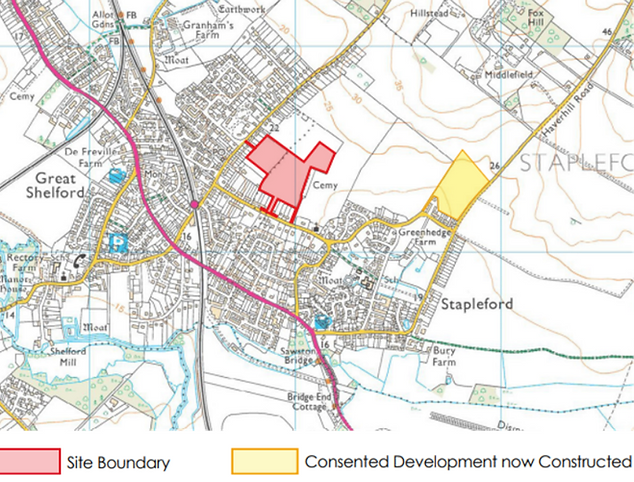
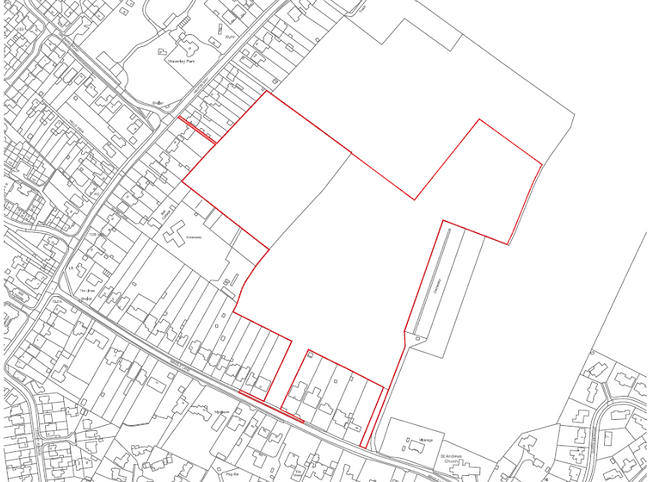
A map of the proposed development behind Mingle Lane, Stapleford and Hinton Way, Great Shelford

A map of the proposed development from the consultation leaflet @Nightingale Land
New equine centre for Stapleford?
Proposals have emerged for new stables in Stapleford.
A planning application has been submitted for a private equine yard, incorporating stables and other ancillary spaces, an all weather manège and associated development.
The equine yard would be at Highwoods on Haverhill Road, Stapleford.
Any final decision would be taken by South Cambridgeshire Council.
Posted March 24 2026.
Stapleford and Shelford Neighbourhood Plan verdict
Villagers have given a big thumbs up to the proposed Neighbourhood Plan for Stapleford and Great Shelford.
Of the people that voted, 95% said yes on a turnout of 25%, which the returning officer said was very respectable for a neighbourhood plan area of our size (i.e. large).
1189 people voted "yes" and 62 voted "no". The turnout was 24.87%.
Our neighbourhood plan will be officially 'made' (i.e. adopted) at SCDC's full Council meeting on 2nd October.
Posted September 22 2025
What is a Neighbourhood Plan?
Neighbourhood planning is a way for communities to take a proactive approach to deciding the future of the places where they live and work and help protect the character of their area. Communities can use a Neighbourhood Plan to help shape the future development and use of land in their neighbourhood reflecting their local pride. This includes the development of homes, green spaces, amenities and infrastructure.
Nearly 1,500 neighbourhood plans have so far been adopted in England. Nine of these are in South Cambridgeshire.
Stapleford & Great Shelford Neighbourhood Plan is at its final stage
South Cambridgeshire District Council has agreed that the Stapleford & Great Shelford Neighbourhood Plan can proceed to a community referendum. This is the final stage of the Neighbourhood Plan process, and it is now up to residents to vote on whether you would like the Stapleford & Great Shelford Neighbourhood Plan to come into force.
What am I voting for?
You are voting whether you think the proposed Neighbourhood Plan should become reality. If you think the character of Stapleford should be protected, vote yes. If you don't care about the character, vote no. If I lives in Stapleford, I would vote yes for the Plan.
Arrangements for our community referendum
The referendum will take place on 4 September 2025. Everyone aged 18 and over who is registered and entitled to vote in local elections and lives in either the parish of Stapleford or Great Shelford can vote. Voting may be done in person (with ID), by post or by proxy. In-person voting will take place between 7am and 10pm at:
-
Stapleford residents: Sheltered Housing Communal Building, Cox’s Close (off Church St), Stapleford, CB22 5SP
-
Great Shelford residents: Memorial Hall, Woollards Lane, Great Shelford, CB22 5LZ.
Look out for your polling card for more details.
A simple yes/no vote
If you choose to vote, you will be asked the following question:
Do you want South Cambridgeshire District Council to use the Neighbourhood Plan for Stapleford and Great Shelford to help decide planning applications in the neighbourhood area?
You will be able to vote ‘yes’ or ‘no’. If more people vote ‘yes’ than ‘no’, then South Cambs Council will adopt the Stapleford & Great Shelford Neighbourhood Plan and it will become part of the development plan for South Cambridgeshire. Our Neighbourhood Plan will be used when making decisions on all planning applications in our area. If more people vote ‘no’ than ‘yes’ in the referendum, then planning applications will be decided without regard to our Neighbourhood Plan.
How can I find out more about the Neighbourhood Plan?
You can view the Stapleford & Great Shelford Neighbourhood Plan and its supporting documents on South Cambs Council’s website at https://bit.ly/4lyPrkE.
Why have a Neighbourhood Plan?
We can't stop development coming to our area but - if or when it does - a Neighbourhood Plan is our best way to shape it in line with our community's expressed needs and priorities.
What you told the Plan organisers is important to you about our villages has been turned into 20 new planning policies covering housing, green spaces, countryside access, amenities and infrastructure. The new policies will protect, enhance and improve these aspects of life in our villages, now and for future generations.
Cumulatively, they offer: a blueprint for the affordability, type, size and look of new housing; sustainability and biodiversity standards for new development; protections for our rural landscape; and proposals for new countryside routes.
Benefits of a Neighbourhood Plan
Neighbourhood planning enables communities to play a much stronger role in shaping the areas in which they live and work and in supporting new development proposals.
A Neighbourhood Plan gives a local community power to decide the future of their area, setting out where new homes, shops, and offices should go, and how they should look, while also protecting green spaces and local character. It allows communities to shape development to meet their specific needs, offering more specific, local planning policies that complement the wider local authority's plans and grant legal weight to community-driven development proposals.
The plan can identify and protect important local green spaces, ensuring they remain for community benefit.
They are a testament to the principle that local people should not simply be told how their community will look by central Government, but be empowered to shape the future of the places they call home.
A plan creates a shared vision for the neighbourhood's future, setting objectives for development over the next 5 to 20 years.
They are optional but can be used to show how a community wants land to be used and developed in its area.
There is also a potential financial benefit. The UK government's Community Infrastructure Levy (CIL) is a charge developers may pay to help fund infrastructure. If we have a Neighbourhood Plan in place, we will receive a higher percentage of CIL revenue—25% instead of 15%—from developments in our area. This money can then be spent on local priorities identified in the Plan.
Downsides of a Neighbourhood Plan
Downsides of Neighbourhood Plans include the extensive time, resources, and commitment required for their creation, which can be a significant burden on communities. There's a risk of creating plans that don't satisfy everyone.
What difference will a Neighbourhood Plan make?
A Neighbourhood Plan is not about preventing all development, but rather about guiding and shaping it in a way that benefits the community and aligns with South Cambs Council’s broader strategic goals.
Why should I vote?
Voting in a neighbourhood plan referendum allows you to directly influence the future of your local area, impacting decisions on everything from new housing to local infrastructure. Your vote decides if the neighbourhood plan is officially adopted and used to guide planning decisions in your community.
A majority 'no' vote on 4 Sept would mean that our Neighbourhood Plan would be disregarded in all planning decisions in our area.
David Martin
Posted August 26 2025
Other pages on the Stapleford Online community website
https://www.staplefordonline.co.uk/news
www.staplefordonline.co.uk/events
www.staplefordonline.co.uk/parish-council
www.staplefordonline.co.uk/businesses
www.staplefordonline.co.uk/community-groups
www.staplefordonline.co.uk/history
www.staplefordonline.co.uk/jobs
www.staplefordonline.co.uk/pavilion
www.staplefordonline.co.uk/planning
www.staplefordonline.co.uk/environment
www.staplefordonline.co.uk/newsletter